Best overall: a basic dry bounce house with a verified setup footprint. Best for overhead clearance: a low-profile dry design; best for a younger guest group: a toddler-specific inflatable approved for those children. This small bounce house rental guide helps San Antonio families compare configurations, measure a tight yard, and prepare a booking request for 2026.
- For a small bounce house rental, start with a basic dry design and verify its complete setup footprint.
- All Texas Party Rentals serves San Antonio families seeking bounce house rentals with delivery and setup.
- Compare gate access, overhead clearance, age suitability, and supervision before choosing an inflatable.
- Choose a compact combo only after confirming space for its slide, exit, blower, and required clearance.
Why this matters in a tight San Antonio yard
A bounce house can fit between your fences and still leave no workable route for delivery, supervision, or guests. The best small-yard rental is the one that fits the complete setup, not just the inflatable's advertised dimensions.
All Texas Party Rentals provides bounce house, water slide, tent, and table rentals with delivery and setup in San Antonio and surrounding areas. Start your request with the San Antonio address and yard details rather than choosing equipment by its photo alone.
For a 2026 backyard birthday, treat the inflatable, seating, shade, and walking route as one layout. A small yard needs room for the party after the rental equipment arrives.
What makes the best small bounce house rental?
Use these criteria before comparing themes or colors:
- Complete setup footprint: Ask for the space required for the inflatable, blower, anchoring, entrance, exit, and operating clearance.
- Delivery access: Check the narrowest opening and every turn between the unloading point and the setup area.
- Overhead clearance: Report branches, roof edges, patio covers, and overhead lines. Let the rental team assess the proposed location.
- Age suitability: Match the exact unit's stated restrictions to the children attending. A small inflatable is not automatically a toddler inflatable.
- Supervision and circulation: Keep the entrance visible and preserve a separate walking route for guests.
- Weather and site suitability: Confirm the accepted surface, operating restrictions, and weather procedures before booking.
These are configuration categories, not product names. Confirm the exact rental unit and its requirements before making a selection.
Small-yard bounce house options at a glance
| Rank and configuration | Best for | Standout feature | Key limitation |
|---|---|---|---|
| Basic dry bounce house | Families prioritizing bouncing over extra features | A straightforward play layout without an attached slide | Its complete setup area still needs verification |
| Low-profile dry bounce house | Sites where inflatable height affects the choice | A lower-height design to evaluate against the site | Lower height does not resolve unsafe overhead conditions |
| Toddler-specific inflatable | Younger guest groups within the unit's restrictions | Equipment intended for a younger age group | Older children need a separate activity plan |
| Compact bounce-and-slide combo | Families wanting bouncing and sliding together | Two activities in one inflatable | The slide and exit add layout demands |
1. Basic dry bounce house: best for a simple backyard birthday
A basic dry bounce house puts the focus on bouncing rather than an attached slide or water activity. Start here when your main goal is to give children an inflatable play area while preserving space for adults, food, and the birthday table.
The design category alone does not establish size. Ask for the exact model's dimensions and its larger required setup area before deciding it fits.
Basic dry bounce house pros:
- Keeps the activity choice straightforward.
- Avoids planning a water supply for inflatable play.
- Lets you assess one entrance and exit arrangement against your party layout.
Basic dry bounce house cons:
- Does not provide a slide activity.
- Still requires space for equipment and operating clearance outside the bouncing area.
- Needs separate planning for guest shade and seating.
Best for: Families whose children primarily want to bounce and whose yard needs a clear, uncomplicated layout.
For your 2026 shortlist, compare basic dry units by required setup space first. A theme should break a tie between suitable units, not determine whether an unsuitable unit goes in the yard.
Verdict: Book a basic dry bounce house when the rental team confirms the full layout and participant suitability.
2. Low-profile dry bounce house: best for checking height constraints
A low-profile dry bounce house is a configuration to ask about when height affects your yard assessment. Compare the exact unit height with the rental team's required overhead clearance; the word low does not establish that a site is suitable.
Do not place an inflatable beneath a patio cover or close to branches based on a visual estimate. Report those features before choosing equipment, and use another location if the proposed setup does not meet the unit's requirements.
Low-profile dry bounce house pros:
- Makes height an explicit part of the equipment comparison.
- Offers a dry-play option without a water-supply plan.
- Gives families another configuration to discuss before abandoning an otherwise usable yard.
Low-profile dry bounce house cons:
- A lower roof does not necessarily mean a narrower footprint.
- Does not solve hazards from overhead lines or unsuitable surroundings.
- Still needs the same access and surface checks as other inflatables.
Best for: Families evaluating an open setup area where the exact inflatable height matters.
Ask for height and required overhead clearance separately. Those are different pieces of information.
Verdict: Hold until the rental team approves the site; skip the location if clearance is unsuitable.
3. Toddler-specific inflatable: best for a younger guest group
A toddler-specific inflatable is worth considering when the birthday group consists of younger children within the exact unit's permitted age and size restrictions. Choose by those restrictions, not by a friendly theme or a small-looking entrance.
A mixed-age party needs an activity plan beyond equipment selection. Ask how the unit's participant rules apply to your guest group and arrange supervision accordingly.
Toddler-specific inflatable pros:
- Centers the decision on the younger children's needs.
- Encourages an age-specific activity plan.
- Gives you a clear reason to separate older children's entertainment.
Toddler-specific inflatable cons:
- Does not automatically suit older siblings or taller guests.
- May not provide the activity older children expect.
- Still requires adult supervision and verified setup space.
Best for: A younger birthday group that meets the selected unit's stated restrictions.
For a 2026 family gathering with cousins of different ages, write down the age range before requesting recommendations. Do not assume one small inflatable is suitable for everyone attending.
Verdict: Book only when the exact unit suits the participating children; plan separately for guests outside its restrictions.
4. Compact bounce-and-slide combo: best for adding a slide
A compact bounce-and-slide combo combines bouncing and sliding in one inflatable. Consider this configuration when both activities matter enough to justify the additional layout checks.
The slide's direction matters as much as the overall dimensions. You need the exit to work with your yard rather than discharge into a fence, furniture, or the main guest route.
Compact bounce-and-slide combo pros:
- Provides bouncing and sliding in one activity area.
- Lets families compare a combined layout against separate equipment.
- Adds an activity without requiring a second inflatable selection.
Compact bounce-and-slide combo cons:
- The slide and exit can make placement harder in a tight yard.
- Compact is not a substitute for exact measurements.
- Wet use requires additional confirmation and planning; never assume a combo supports it.
Best for: Families whose measured yard accommodates the complete combo setup without sacrificing guest circulation.
Compare the actual layout against a basic dry bounce house. If the slide consumes the space needed for supervision or access, choose the simpler configuration.
Verdict: Book only after confirming the slide orientation, exit area, and complete setup footprint.
Measure the yard before requesting a booking
For your 2026 booking request, record 3 measurements in feet: usable length, usable width, and the narrowest access width. Ask the rental team how to assess overhead clearance; do not approach overhead lines to measure them.
Measure the usable area, not the property boundary. Exclude fixed obstacles and the space you need to keep clear for the party.
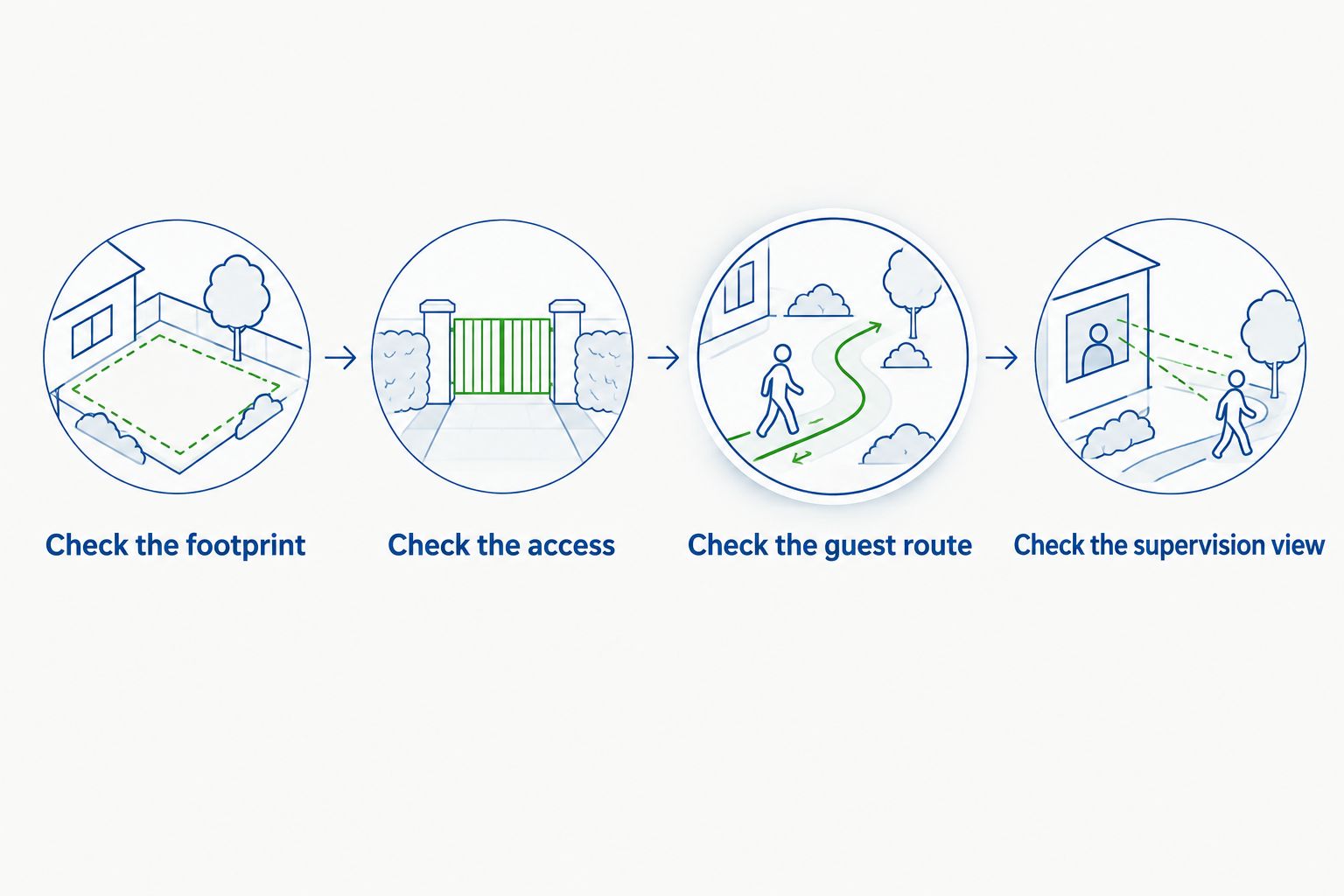
Check the footprint
Mark where the inflatable could sit and identify fences, trees, garden beds, irrigation equipment, slopes, and hardscape. Report the actual surface rather than describing the yard simply as large or small.
Check the access
Follow the delivery route from the likely unloading point. Include gates, steps, tight corners, and anything that prevents equipment from reaching the proposed location.
Check the guest route
Sketch how guests will move between the house, seating, refreshments, and inflatable entrance. Keep that route distinct from the play exit and equipment area.
Check the supervision view
Identify where the supervising adult will stand with an unobstructed view of the activity. Do not use the only clear viewing position for a food table or storage.
Take 2 photos to begin the conversation: one showing the proposed setup area and one showing the narrowest access point. Add other views when turns, obstacles, or surface changes need explanation; photos do not replace the rental team's assessment.
Shade, weather, and equipment need separate space
A San Antonio backyard plan needs a place for guests to get out of direct sun. A bounce house is not a substitute for a separate shaded seating area.
If you also want a tent, show both pieces of equipment on the same sketch. Ask the rental team to confirm their placement and required separation rather than fitting the tent into whatever space remains.
Before confirming your small bounce house rental, ask:
- What surface and anchoring arrangements does the exact unit require?
- Where must the blower sit, and what electrical supply is needed?
- Which weather conditions stop setup or operation?
- Who communicates a weather-related change, and when?
- What should the supervising adult do if conditions change during the party?
Use the unit's instructions and the provider's confirmed procedures. Do not substitute an internet wind threshold or a general weather forecast for those operating requirements.
Send a booking request that resolves the details
All Texas Party Rentals is a fit for San Antonio families seeking bounce house rentals with delivery and setup. Make your request specific enough to confirm equipment suitability, not just whether a date can be discussed.
Include the event address, date, party hours, children's age range, surface, measurements, access photos, and preferred configuration. Ask for the exact unit name, setup requirements, delivery and pickup arrangements, and an itemized quote.
Use the contact page to send those details. Confirm what the quote includes and what remains your responsibility before completing the booking.
Request a small-yard rental quote
Share your San Antonio address, party date, yard measurements, access photos, and children’s age range.
How these configurations are ranked
The ranking prioritizes a straightforward play layout, then height constraints, younger participants, and an added slide. It is a decision guide, not a comparison based on product testing or a claim that any configuration fits every small yard.
The deciding criteria remain the same: setup footprint, delivery access, overhead clearance, age suitability, supervision, and site conditions.
Which small bounce house should you choose?
Start with a basic dry bounce house unless your children's needs or the verified site requirements point elsewhere. It keeps the initial decision focused on bouncing rather than additional features.
Choose a toddler-specific unit for an eligible younger group, assess low-profile designs when height matters, and consider a combo only when its complete layout works. For 2026 planning, a confirmed fit matters more than the smallest-looking photo.
FAQ
What’s the best small bounce house rental for a tight backyard?
A basic dry bounce house is the starting choice when you want bouncing without an attached slide. Confirm the exact unit’s complete setup footprint, delivery access, and participant restrictions before booking.
How much yard space do I need for a small bounce house?
You need the exact unit’s required setup area, not just its inflatable dimensions. Ask for the space needed for the blower, anchoring, entrance, exit, and operating clearance.
Can a bounce house fit through my backyard gate?
The rental team must confirm access for the selected equipment. Send the narrowest gate measurement and photos showing steps, corners, and the route to the setup area.
Is a small bounce house suitable for toddlers?
Small size does not establish toddler suitability. Choose a unit whose stated age and size restrictions match the participating children, and follow its supervision requirements.
Is a compact combo better than a basic bounce house?
A compact combo is the better choice only when you want a slide and the complete layout fits. A basic dry bounce house is the simpler starting point when space and guest circulation take priority.
What should I send All Texas Party Rentals before booking?
Send your San Antonio address, event date, party hours, children’s age range, yard measurements, surface details, and access photos. Ask for confirmation of the exact unit, setup requirements, delivery arrangements, and quote inclusions.
Can I put a small bounce house under a tree or patio cover?
Do not assume that location is suitable. Report branches, roof edges, covers, and overhead lines so the rental team can assess clearance and approve or reject the proposed setup.
One last thing
Walk the route from your back door to the proposed inflatable entrance while imagining guests carrying drinks and children returning from play. If everyone must cross the exit or squeeze past equipment, revise the layout before booking.
A smaller activity with a clear guest route is a better choice than a feature-packed setup that blocks the party.
