Best overall: a straight-through obstacle course. Best for head-to-head games: a dual-lane course. Best for limited space: a compact course. Best for water play: a course expressly approved for wet use. This 2026 guide helps you choose an inflatable obstacle course rental for a San Antonio birthday by matching the layout to your children, yard, and setup requirements—not the biggest-looking inflatable.
- Choose a straight-through inflatable obstacle course rental as your starting point, then verify age suitability and setup space.
- Choose dual lanes for head-to-head games, not simply because the inflatable looks larger.
- All Texas Party Rentals offers San Antonio bounce house, tent, and table rentals with delivery and setup.
- Confirm the exact unit, access route, operating instructions, and weather terms before booking.
Why this matters
An obstacle course adds movement between activities, but the layout must work for the children using it. A course that suits older children does not automatically suit younger siblings, and an inflatable that fits on paper still needs an approved setup area and delivery access.
All Texas Party Rentals provides bounce house, water slide, tent, and table rentals with delivery and setup in San Antonio and surrounding areas. When asking about an obstacle course, request the exact unit information rather than assuming a particular layout is part of the rental selection.
The recommendations below compare rental formats, not verified models or inventory. Use them to narrow your request before you commit to a birthday-party booking.
What makes the best inflatable obstacle course rental?
Judge a course by these criteria before comparing its appearance:
- Age suitability: Ask for the specific unit’s user restrictions and operating instructions. A birthday age alone does not describe every guest.
- Usable space: Compare the required setup area with your clear yard space, including overhead clearance and surrounding obstacles.
- Delivery access: Check gates, turns, steps, slopes, and the route from unloading to setup.
- Play format: Decide whether children want continuous turns, paired races, or an activity that accommodates different confidence levels.
- Operating requirements: Confirm power, anchoring, supervision, weather restrictions, and water requirements where relevant.
- Booking clarity: Get the unit identification, rental period, delivery arrangements, and applicable terms in writing.
The best course is the one your group can use as directed in the space you actually have. For a 2026 backyard birthday, answer those questions before choosing a theme or color.
Inflatable obstacle course formats at a glance
| Format | Best for | Standout feature to request | Key limitation |
|---|---|---|---|
| Straight-through course | A straightforward birthday activity | A clear entrance-to-exit route | Children still need supervision and controlled turns |
| Dual-lane course | Head-to-head birthday games | Separate parallel routes designed for paired play | Requires suitable participants and room for its approved setup |
| Compact course | A yard with restricted usable space | A layout that fits the measured site | Compact does not establish age suitability or delivery access |
| Wet-use-approved course | A party specifically planned around water play | Explicit approval and instructions for wet operation | Adds water, drainage, and wet-area planning |
These are decision categories, not product specifications. Obtain the actual dimensions and restrictions for the unit offered; names such as compact or giant are not measurements.
1. Straight-through course: best for a straightforward birthday
A straight-through obstacle course gives children a route from an entrance to an exit. Depending on the actual model, that route can include passages, obstacles, climbing features, or a slide; verify the details rather than expecting every feature.
Start here when your priority is an understandable activity instead of a competition. You can plan the waiting area and exit around a defined direction of travel, then follow the provider’s rules for entry and spacing.
Straight-through course pros:
- Gives you a clear route to explain before play begins.
- Lets you organize turns without making every turn a race.
- Provides a useful starting format when comparing different models.
Straight-through course cons:
- Does not eliminate queues or the need to supervise entry.
- A taller or more challenging section can still rule out particular users.
- The entrance and exit need space within the approved layout.
Best for: Families who want an obstacle activity without building the entire party around paired competition.
Verdict: Buy this format if the exact course meets your group’s restrictions and your site requirements. Treat it as the default to investigate, not an automatic booking.
2. Dual-lane course: best for head-to-head birthday games
A dual-lane course uses parallel routes for paired play. Confirm that the particular unit is designed for simultaneous participants and ask how the operator requires children to be grouped.
Choose this format because your guests want races, not because dual lanes sound automatically better. The party plan should also work for children who prefer to watch or take a noncompetitive turn where the operating rules permit it.
Dual-lane course pros:
- Gives head-to-head games a defined layout.
- Makes paired turns part of the activity rather than an improvised rule.
- Suits a birthday plan centered on organized challenges.
Dual-lane course cons:
- Competition does not suit every child.
- Parallel lanes do not establish a safe participant combination.
- The setup still needs the exact model’s required space and access.
Best for: A group that actively wants paired games and meets the course’s user requirements.
Verdict: Buy for a race-focused party; skip this format when competition is not the point. Do not assume the layout solves a large guest list without checking the operating limits.
3. Compact course: best for restricted usable yard space
A compact obstacle course is a candidate for a smaller setup area, but the description alone tells you little. Request the full required setup footprint, not just the inflatable’s dimensions.
Measure around the features you cannot move: fences, trees, sheds, patios, and overhead obstructions. If no suitable obstacle course fits, a different activity is a better decision than squeezing equipment into an unsuitable space.
Compact course pros:
- Keeps the search focused on your usable area.
- Encourages a simpler layout request instead of unnecessary features.
- Gives you a direct alternative to asking for the largest course.
Compact course cons:
- The word compact is not a standardized size specification.
- A smaller footprint does not establish suitability for toddlers.
- A unit can fit the lawn but still fail the delivery-access check.
Best for: Families whose measured site is the main constraint.
Verdict: Hold until the provider approves both the setup area and the access route. Do not substitute a product photo for that confirmation.
4. Wet-use-approved course: best for planned water play
Choose a water-based obstacle activity only when the exact unit is expressly approved for wet use. A dry course does not become a water attraction because you add a hose.
For a San Antonio party, water play also changes the surrounding plan. Ask about the required water connection, hose routing, drainage, and how to keep the waiting and seating areas out of runoff.
Wet-use-approved course pros:
- Fits a birthday specifically organized around water play.
- Lets you plan water access and dry seating before setup.
- Provides a clear category to discuss instead of modifying dry equipment.
Wet-use-approved course cons:
- Requires confirmation of wet-use approval and operating instructions.
- Adds drainage and wet-ground considerations.
- Does not replace weather monitoring or the unit’s shutdown rules.
Best for: Families prepared to manage a water-play layout as well as the inflatable itself.
Verdict: Hold until wet operation, water access, and drainage are confirmed. Skip improvised water use on a dry-only course.
Turn your yard into a booking-ready plan
Before requesting a 2026 rental, collect 3 measurements: usable length, usable width, and clear height. Ask the provider how to measure overhead clearance safely; do not approach utility lines or other hazards.
Then take 2 photos: the proposed setup area and the narrowest access point. These are useful starting materials for a site discussion, not a substitute for the provider’s approval.
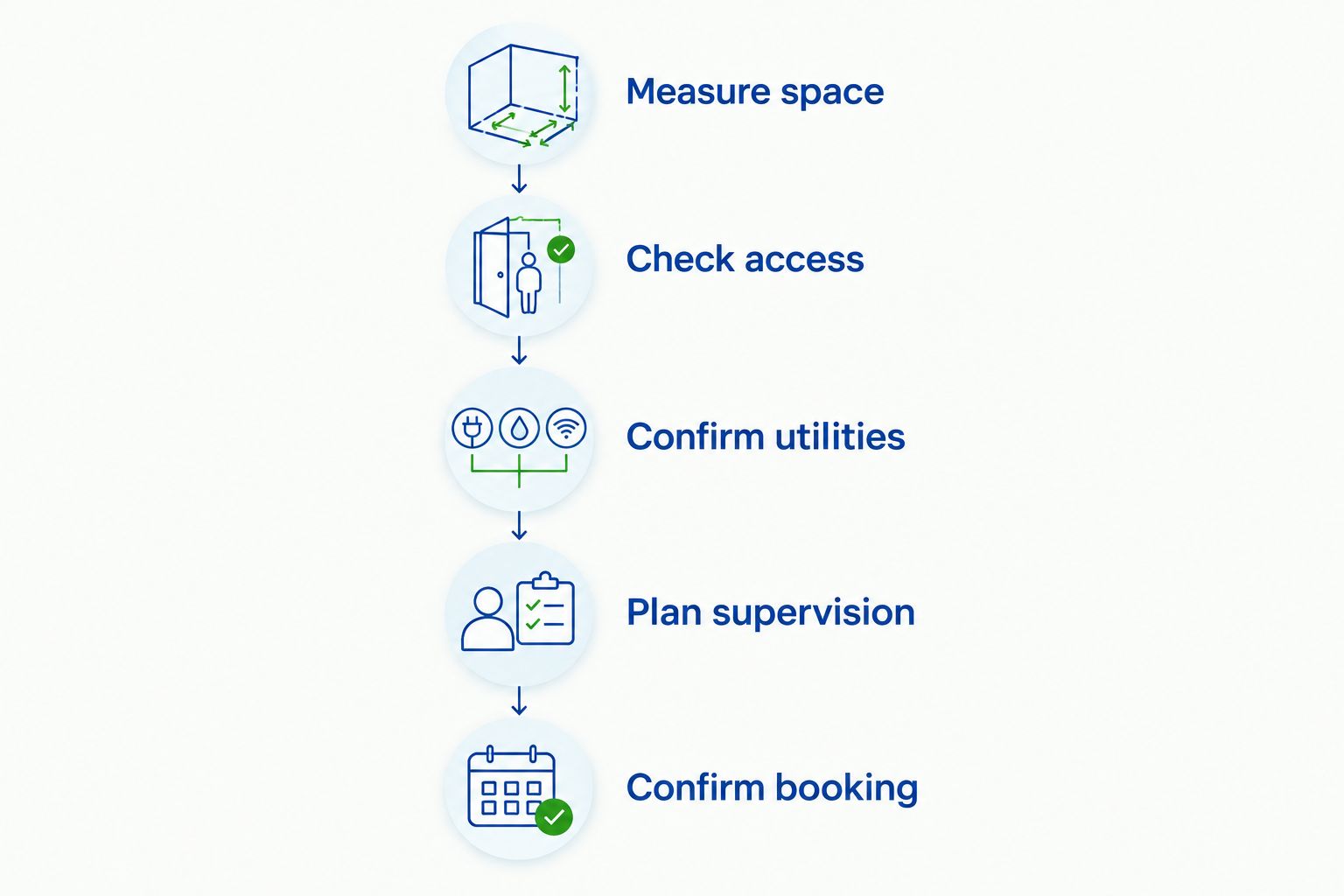
Use this sequence:
- Measure space. Mark the usable area without counting space occupied by permanent obstructions.
- Check access. Describe gates, sharp turns, steps, surface changes, and slopes along the delivery route.
- Confirm utilities. Ask what power is required and whether the proposed connection is suitable. For wet use, confirm water requirements too.
- Plan supervision. Identify who will follow the operating instructions and manage the waiting area.
- Confirm booking. Get the agreed equipment and arrangements recorded before treating the activity as settled.
Keep the waiting area separate from the exit and preserve access through the yard. If you also need a tent or tables, include those in the layout discussion instead of treating the remaining space as automatically usable.
What to confirm before you book
For your 2026 party, send the address, date, planned use period, guest age range, measurements, and site photos together. Ask All Texas Party Rentals whether an obstacle course matching your requirements can be quoted, and request the exact unit details before selecting it.
Your booking questions should cover:
- Equipment: Which exact unit is proposed, and what features does it have?
- Users: What restrictions apply, and how should different ages or sizes be managed?
- Setup: What area, surface, anchoring, access, and utilities are required?
- Timing: What delivery, setup, rental-period, and collection arrangements apply?
- Quote scope: Which charges and services are included, and which are separate?
- Weather: What operating restrictions and cancellation or rescheduling terms apply?
- Supervision: What must the responsible adult do during use?
Aim for 1 written confirmation that identifies the equipment and agreed arrangements. Use the contact page to start that discussion rather than treating a general inquiry as a confirmed reservation.
Confirm your birthday rental requirements
Send your San Antonio address, party date, guest ages, and yard details to discuss a suitable rental.
How these formats were ranked
This 2026 guide ranks formats by decision fit: a straightforward activity first, then paired competition, restricted space, and planned water play. The criteria are age suitability, site requirements, access, play format, operating requirements, and booking clarity.
This is not a model-by-model performance test. A course earns your booking only after its specific requirements match your party.
Which obstacle course should you choose?
Start with a straight-through course unless you have a clear reason to choose another format. Choose dual lanes for paired games, compact equipment for an approved smaller site, or wet-use-approved equipment for a water-play party.
All Texas Party Rentals is a practical starting point for San Antonio families coordinating bounce house rentals with tents and tables. For an obstacle course rental, confirm the exact equipment first; the company’s broader event-rental services do not establish a particular course’s specifications.
FAQ
What’s the best inflatable obstacle course rental for a backyard birthday?
A straight-through course is the starting recommendation for a straightforward backyard birthday activity. Book only after the exact unit meets the children’s user restrictions and the site’s setup requirements.
Is a dual-lane obstacle course better than a straight-through course?
A dual-lane course is better suited to a party built around paired races. A straight-through format is the starting choice when competition is not the main activity.
How do I know whether an obstacle course will fit my yard?
Compare your usable length, width, and clear height with the provider’s required setup area. Also confirm the delivery route, overhead obstructions, surface, anchoring, and utility requirements.
Can toddlers use an inflatable obstacle course?
Toddler suitability depends on the specific unit’s user restrictions and operating instructions. Do not assume that a compact course is toddler-appropriate or that younger children can share with older guests.
Can I add water to a dry inflatable obstacle course?
Use water only on equipment expressly approved for wet operation. Ask for the exact unit’s instructions and confirm the water connection, drainage, and surrounding layout.
What should I ask All Texas Party Rentals before booking?
Ask which exact equipment matches your party date, guest ages, address, and site requirements. Confirm the quote scope, delivery and setup arrangements, operating instructions, and applicable weather terms.
What happens if bad weather affects my birthday rental?
Follow the specific equipment’s operating restrictions and the rental provider’s instructions. Confirm cancellation, rescheduling, and shutdown terms before booking rather than assuming a tent or water feature resolves weather concerns.
One last thing
Walk the delivery route before you choose the inflatable. A suitable lawn does not guarantee suitable access, and a gate photo alone does not show the turns beyond it. For your 2026 birthday plan, send the full route description with the yard measurements so the equipment decision starts with the site—not the invitation theme.
